What AI archetype are you?
Summary: After working with over 70 agencies, we noticed that different organisations had vastly different motivations, fears, and definitions of success. Mapping those patterns led us to four distinct AI archetypes. Knowing which one describes your agency is the starting point for building a strategy that actually holds.
Author: Asta Vallis
Read time: 4 minutes
Date: 29.05.2026
Spark is an AI training and transformation partner. We build AI capability inside agencies and brand teams – providing the training, governance and practical tools your team needs to harness AI across your whole organisation.
What kind of agency are you, really?
When it comes to AI, not everyone is playing the same game. The mistake most agencies make is assuming that what works for a performance-driven network will work for a craft-led independent, or that an operational fix applied in one context will translate cleanly to another. It does not.
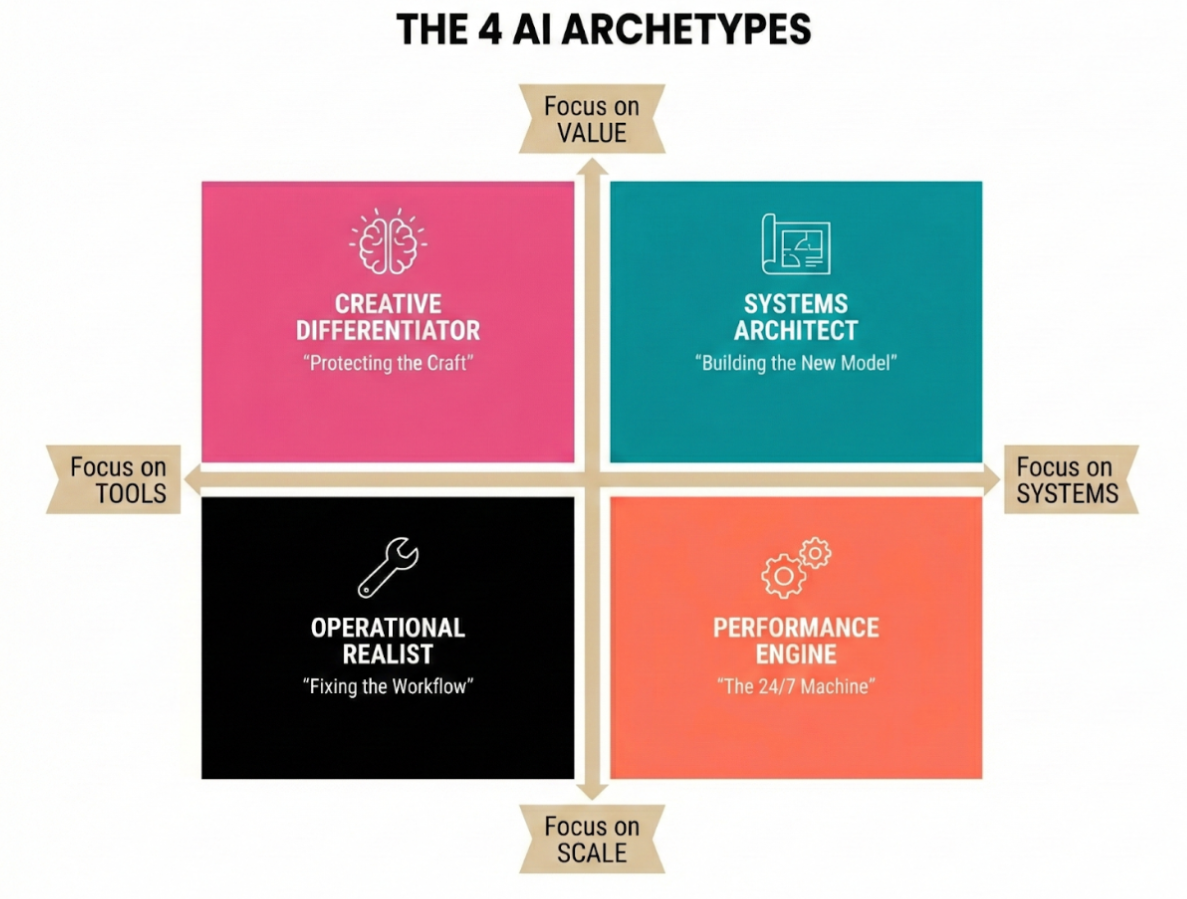
After working closely with over 70 agencies, we identified four distinct AI archetypes: the Creative Differentiator, the Operational Realist, the Systems Architect, and the Performance Engine. Each has different motivations, different pressure points, and a fundamentally different relationship with what AI is actually for. Knowing which one describes your organisation is the only way to build a strategy that fits.
Are you a Creative Differentiator?
If your agency's value lives in bespoke thinking and distinctive craft, you are a Creative Differentiator. Your clients pay for your sensibility as much as your output, and that creates a specific tension with AI. The question is never whether to use it. The question is how to use it without flattening the very thing that makes your work worth buying.
For this archetype, the most effective use of AI is reclaiming time. Automating administrative and operational tasks to protect space for high-level creative thinking. Custom models trained on internal archives can help maintain a house style without producing the kind of generic output that erodes reputation. The core fear here is usually data security and the risk of AI mistakes surfacing publicly. Both are manageable with the right governance in place.
Are you an Operational Realist?
Operational Realists are focused on the mechanics of running the business well. AI is a practical tool — a way to reduce friction, speed up delivery, and bring costs under control. There is less interest in transformation for its own sake, and more interest in fixing the specific bottlenecks that slow teams down.
The advantage of this archetype is pragmatism. Because the focus is on specific, solvable problems, results come quickly and they are easy to demonstrate. That matters internally. Early wins build the organisational appetite for broader adoption in a way that top-down mandates rarely do. The tension sits elsewhere. Automating workflows can feel threatening to existing team culture, and the people asked to change their working practices are often the same people whose buy-in you need most. Managing that carefully is what separates successful adoption from the kind that creates resentment.
Are you a Systems Architect?
Systems Architects are thinking at a different scale entirely. They see AI as the infrastructure for a new business model, and they recognise that selling billable hours has a ceiling that AI will accelerate. The goal is to move from service provider to platform builder, developing proprietary tools and AI agents that generate value at a scale no traditional team structure could match.
This is the most ambitious archetype, and the most structurally disruptive. The shift from billing for time to charging for outcomes requires the whole organisation to move together. That is also where it tends to stall. Bringing a workforce along on a structural change of this scale is genuinely hard, and the leaders who manage it well are the ones who invest as much in communication and culture as they do in the technology itself.
Are you a Performance Engine?
Performance Engines operate at volume, often across multiple markets, with aggressive targets and clear metrics. AI is not a strategic opportunity here so much as a commercial necessity. The question is not whether to adopt it, but how quickly it can be embedded at scale.
The practical priorities for this archetype are consistency and compliance. Managing content that functions legally and accurately across different territories is a real and complex problem, and AI can help solve it. The cultural challenge is different from the other archetypes. In high-volume environments, the concern is less about craft being diluted and more about a workforce that has built its identity around speed and output feeling displaced by systems that do the same thing faster.
Where do you sit?
Most agencies recognise themselves primarily in one archetype, with elements of another. That is fine. What matters is being honest about where your organisation actually sits, not where you would like it to sit, or where you think the industry expects you to be.
The archetype that fits you determines everything: which tools are worth investing in, how you sequence adoption, how you communicate change internally, and what success actually looks like. Without that clarity, AI strategy tends to become a series of disconnected experiments that never quite add up to anything.
Try our free Spark AI Maturity Score to see where you stand with AI.
Frequently Asked Questions
How does identifying an archetype improve AI implementation?
It gives your strategy a centre of gravity. A Creative Differentiator needs a very different approach to AI adoption than a Performance Engine. When strategy is aligned with what your business actually values, AI investment stops being scattered and starts compounding.
Can agencies move between archetypes?
Yes. Agencies may start as Operational Realists, fixing immediate workflow problems, and evolve into Systems Architects as they develop proprietary tools and begin to see new revenue models. The archetypes are not fixed identities. They are a way of understanding where you are now.
What is the risk of ignoring this?
You end up solving the wrong problems well. An agency that should be protecting its creative distinctiveness might pour energy into operational efficiency. Archetype clarity is not about labelling yourself. It is about making sure your AI investment is pointed in the right direction.
Ready to move beyond fragmentation?
Turn fragmented AI experimentation into organisation-wide AI capability – with impact, control and confidence.https://www.wearespark.ai/