Do agencies really need more than three AI tools?
Summary: This post argues that agencies can handle the majority of their workflows with just three core AI tools — and explains why a simpler stack can lead to better results.
Author: Asta Vallis
Read Length: 4 minutes
Date: 13.05.2026
Spark AI is a strategy-led consultancy helping agency and brand teams move from fragmented experimentation to organization-wide capability. Our blog provides the strategic techniques, insights and industry discussions needed to navigate AI with confidence.
Is your AI tool stack working against you?
Thousands of new AI tools launch every month. For most agencies, that is less an opportunity than a distraction. The instinct to test every release, maintain every niche subscription, and keep pace with every product announcement is understandable. It is also expensive, and it produces cluttered tech stacks that nobody uses well.
The agencies building durable AI capability are doing the opposite. They go deep on a small number of tools rather than wide across many.
Why do most AI tools look and feel the same?
The vast majority of tools on the market are built on a handful of foundation models, such as ChatGPT or Stable Diffusion. Developers take those models, add a user-friendly interface and some pre-written instructions, and package the result as a specialist product. The underlying intelligence is the same. What you are paying for is the wrapper.
When your team holds multiple licences for tools that all pull from the same source, the costs compound quickly without a proportional return. Capability lives in the model. What unlocks that capability is skill — and skill requires focus.
Which three tools should creative agencies actually be using?
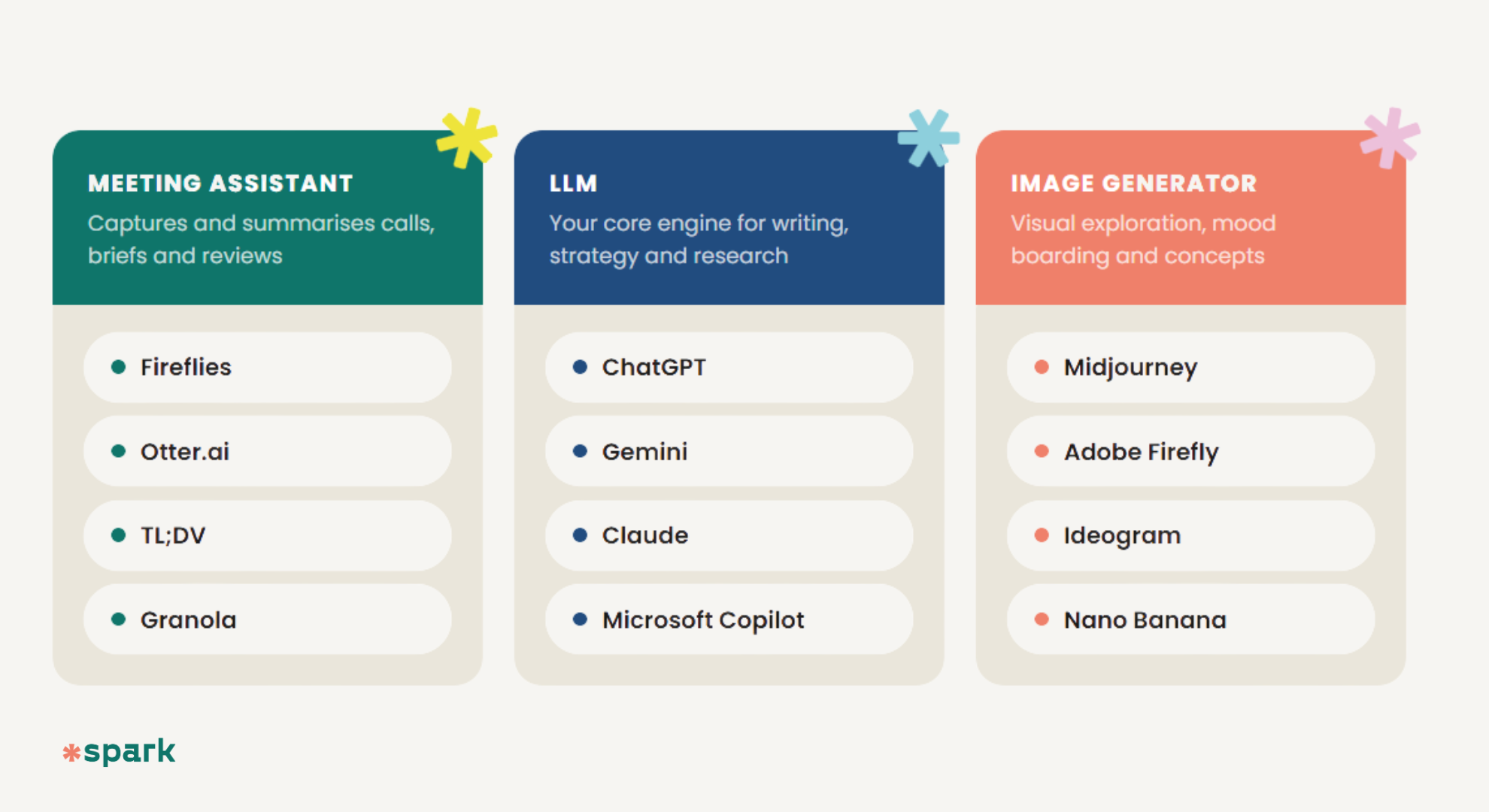
We recommend focusing on three functional categories to move from ad-hoc use to an embedded capability.
The first is a meeting assistant. Tools like Fireflies, Otter, or TL;DV capture the unstructured, context-rich conversations that happen in briefs, client calls, and internal reviews. This captured context becomes highly useful input for your other tools. Feeding a well-structured transcript into an LLM turns a meeting into a strategy document, a set of action points, or a first draft brief in minutes. We still recommend that you take notes for key information, as the act of writing can help with memory.
The second is a large language model. ChatGPT, Gemini, Copilot and Claude are your core engine for strategy, research, writing, and creative development. Which one you choose matters less than how well you learn to use it. These models leapfrog each other in capability on a near-monthly basis. Pick the one that integrates best with your existing platforms and build skill within it.
The third is an image generator. Midjourney, Krea, Nano Banana and Freepik are well-suited to visual exploration, mood boarding, and concept development. For agencies, this is where AI accelerates the early stages of creative work. The generating references, exploring directions, and communicating ideas to clients before committing to production.
While we have listed examples of tools per category, we always recommend that the best tool is the one that your team is already using. Tools are constantly updating and competing, so switching models constantly doesn’t build sustainable AI capacity. Stick with one tool, and become very good at that.
What does this mean for how agencies should build their AI practice?
Walk before you run. The agencies building durable AI capability go deep on a small number of tools rather than wide across many. Mastery compounds. A team that genuinely understands how to work with an LLM will consistently outperform a team holding twenty subscriptions and using none of them well.
Does reducing the number of AI tools improve agency security?
Security is often the quiet casualty of rapid AI adoption. When employees use personal accounts and unvetted tools — what is often called shadow AI — they create real vulnerabilities around data privacy and intellectual property. A consolidated stack of three core tools makes governance practical rather than theoretical. It gives leadership a clear framework for safe use, defined standards, and confidence that client data is protected and that your agency's IP is not being used to train public models without your knowledge or consent.
Frequently asked questions:
If I already subscribe to both ChatGPT and Gemini. Isn't that better than just one?
Not necessarily. These models have different strengths, but running both tends to fragment workflows — prompts scattered, context lost, standards inconsistent across the team. The competitive advantage comes from depth, not breadth. Pick one as your primary engine, build real skill within it, and let that compound across your whole team.
Will a limited toolset stifle creative innovation?
Innovation comes from focus, not volume. When a team moves from surface-level use across twenty tools to real proficiency in three, they stop fighting the interface and start pushing the model. That is where the more interesting, more sophisticated work happens — the kind where AI handles the execution and your team concentrates on what only they can do.
Will using AI tools damage the trust we have built with clients?
Clients in 2026 are less concerned with whether you use AI than with how you govern it. A consolidated, vetted stack gives you a clear answer when they ask about data security and IP protection. That clarity builds trust. Your team retains responsibility for strategic direction and creative judgement. AI handles the mechanical load.
Harness AI across your organisation – and deliver more for your clients, protect your margins and create opportunities that simply didn't exist before. https://www.wearespark.ai/