
What counts as data?
Summary: Most people think of data as spreadsheets and reports, but actually 80% of the data inside a business is unstructured, such as briefs and transcripts. AI can now read all this, and help sharpen how you operate, improve your M&A due diligence, and retain your institutional knowledge. We break down the five types of data your agency already has, how to protect your data, and the opportunities it presents.
Date: 15th July 2026
Author: Asta Vallis
Read time: 4 minutes
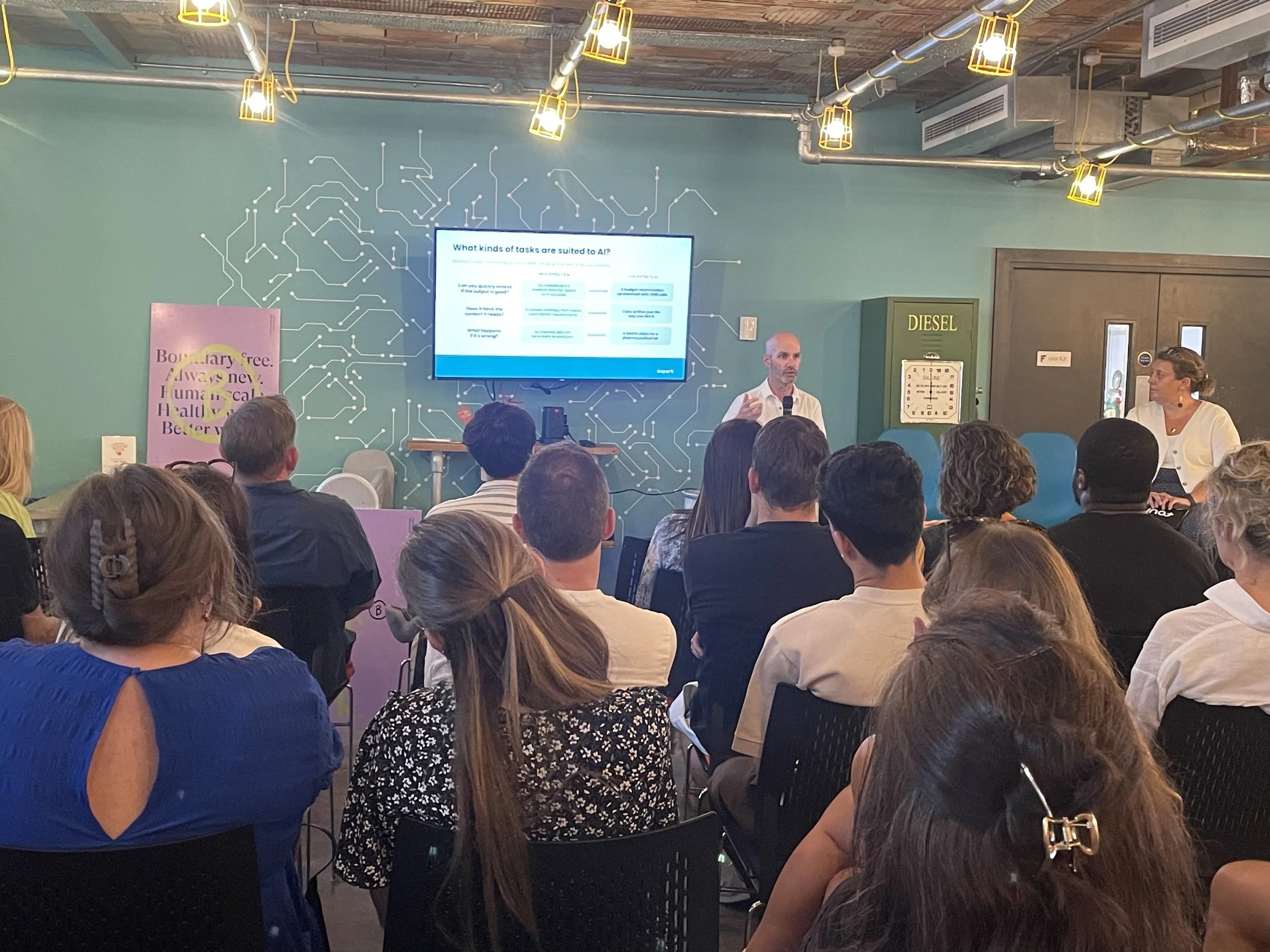
What do people get wrong about "data"?
Mention "data strategy" and most people think of structured reports and spreadsheets. But 80% or more of an organisation's data is unstructured. It's often called dark data, and until recently, computers couldn't read it. It just sat there, buried in email threads and meeting notes. AI has changed that completely. It can now make sense of all the messy, human information that used to be invisible to any system.
Once you stop thinking of data as only numbers and start thinking of it as institutional memory, AI can help turn that untapped data into competitive advantage.
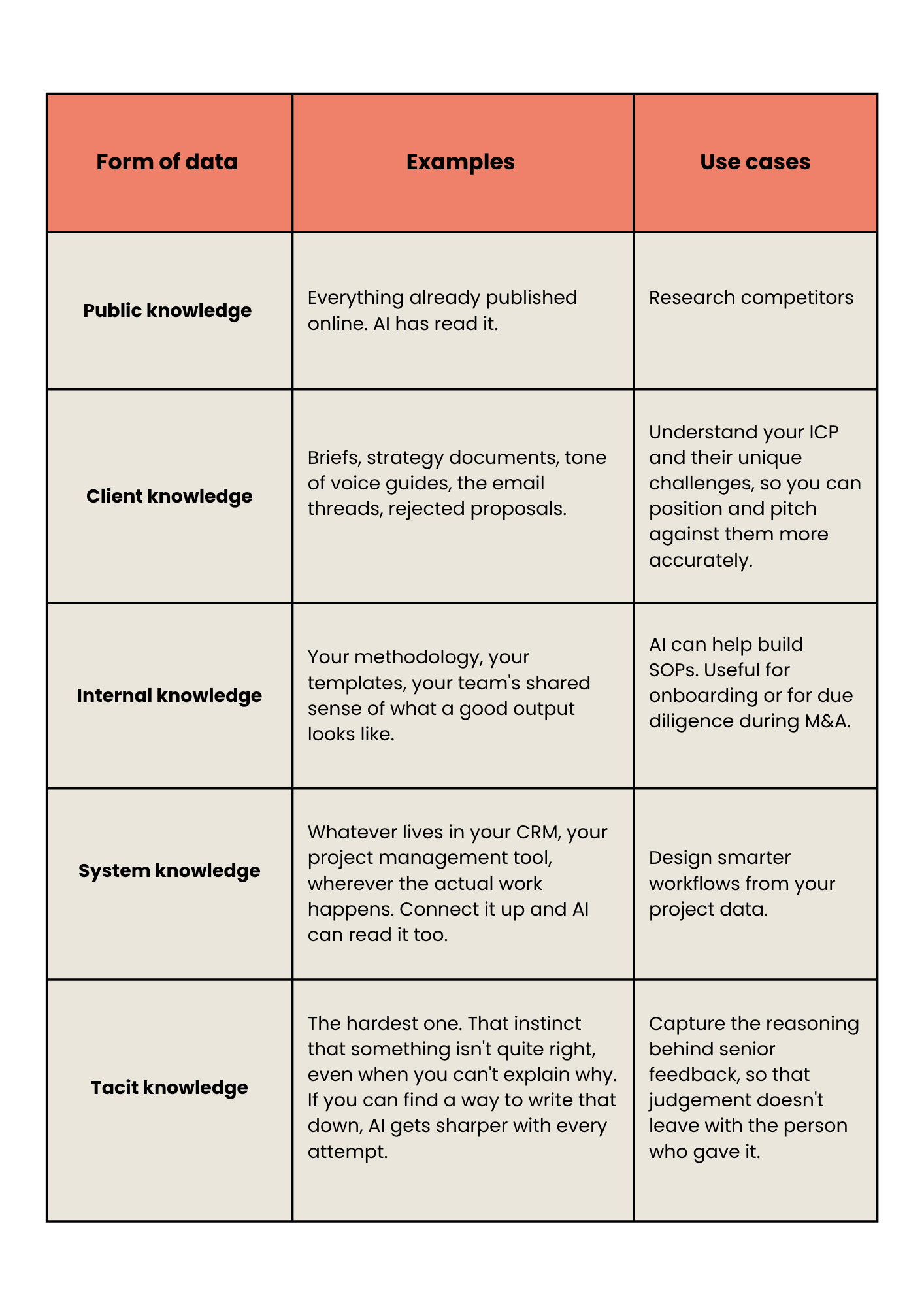
What are the five types of data an agency can use?
At Brandland event in Norwich, our co-founder, Jules, broke this down into five categories.
What's the real risk of not having a data policy?
The Spring edition of the Spark Report found that 52% of AI activity across agencies is still informal.
Without that standard, it's easy for one client's confidential data to end up feeding a brief for a completely different client.
Only 25% of agencies have updated their client contracts to reflect how AI is actually being used in delivery (Wow Benchpress survey, 2026). That leaves 75% exposed to contractual ambiguity, right as clients are starting to ask harder questions about how their data is handled.
How can agencies make their data safe?
Start by making a traffic light system for data use.
Green for AI friendly work, amber for internal use only, red for confidential briefs where AI isn't involved at all.
It takes the decision off the individual and makes it something the whole agency follows.
What are the opportunities of using unstructured data?
Sharper insights. When your data is organised rather than scattered across inboxes and old folders, AI can spot patterns you'd never have time to find manually, such as shifts in client language or recurring objections.
Stronger positioning for M&A or investment. Acquirers are already treating AI maturity as a valuation factor. Having your data structured, governed, and usable is proof of exactly the kind of operational maturity buyers look for.
Better pitches. Client knowledge that's properly organised means you can walk into a pitch already speaking to a prospect's specific challenges, rather than relying on a generic deck and hoping it lands.
Faster onboarding. New starters and new team members on an account can get up to speed against real briefs, past feedback, and institutional knowledge, instead of waiting weeks to pick it up secondhand.
Explore our AI for Operations programme, designed to turn exactly this kind of scattered, unstructured information into clean, usable records your team can actually rely on.
Frequently Asked Questions
What's one thing I can do today to make my data more useful?
Start naming things properly. A file called "Final_v3_edits_USE THIS ONE" tells AI nothing. A file called "Client Name, Brand Guidelines, 2026" tells it everything it needs. Consistent, descriptive naming is the simplest way to turn a messy folder into something AI, and your team, can actually search and use.
Is it safe to use free AI tools like ChatGPT with client data?
No. Free consumer versions of most AI tools use the conversations and files you feed them to retrain their models. This means it can end up informing outputs for other users elsewhere. If your team is doing any client work in AI tools, you need to be on an enterprise or business plan (Claude for Work, ChatGPT Team or Enterprise, Gemini Business, or equivalent).
What actually counts as "data" for AI?
Data is everything. Most people think of it as structured notes, spreadsheets or reports. But there's immense value sitting in the unstructured stuff too: meeting transcripts, old email threads, creative briefs, brainstorm notes. AI now has the ability to make sense of all of it, so worth exploring its potential.