Why did we create the Spark AI Maturity Model®?
Summary: We explain why we built the Spark AI Maturity Model® to give agencies a consistent way to benchmark AI adoption over time. The blog also shows what the model measures, where most agencies are at, and how to read results across its four dimensions.
Author: Asta Vallis
Read length: 4 minutes
Date: 12.08.26
Spark AI is the AI performance partner that builds organisation-wide AI capability for creative agencies and brand teams. We take ambitious teams from fragmented experimentation to AI embedded across their people, processes and systems – so it delivers real commercial impact.
Take our free AI Maturity Score to see where you stand on the Spark AI Maturity Model® - or read our blog explaining why we made it.
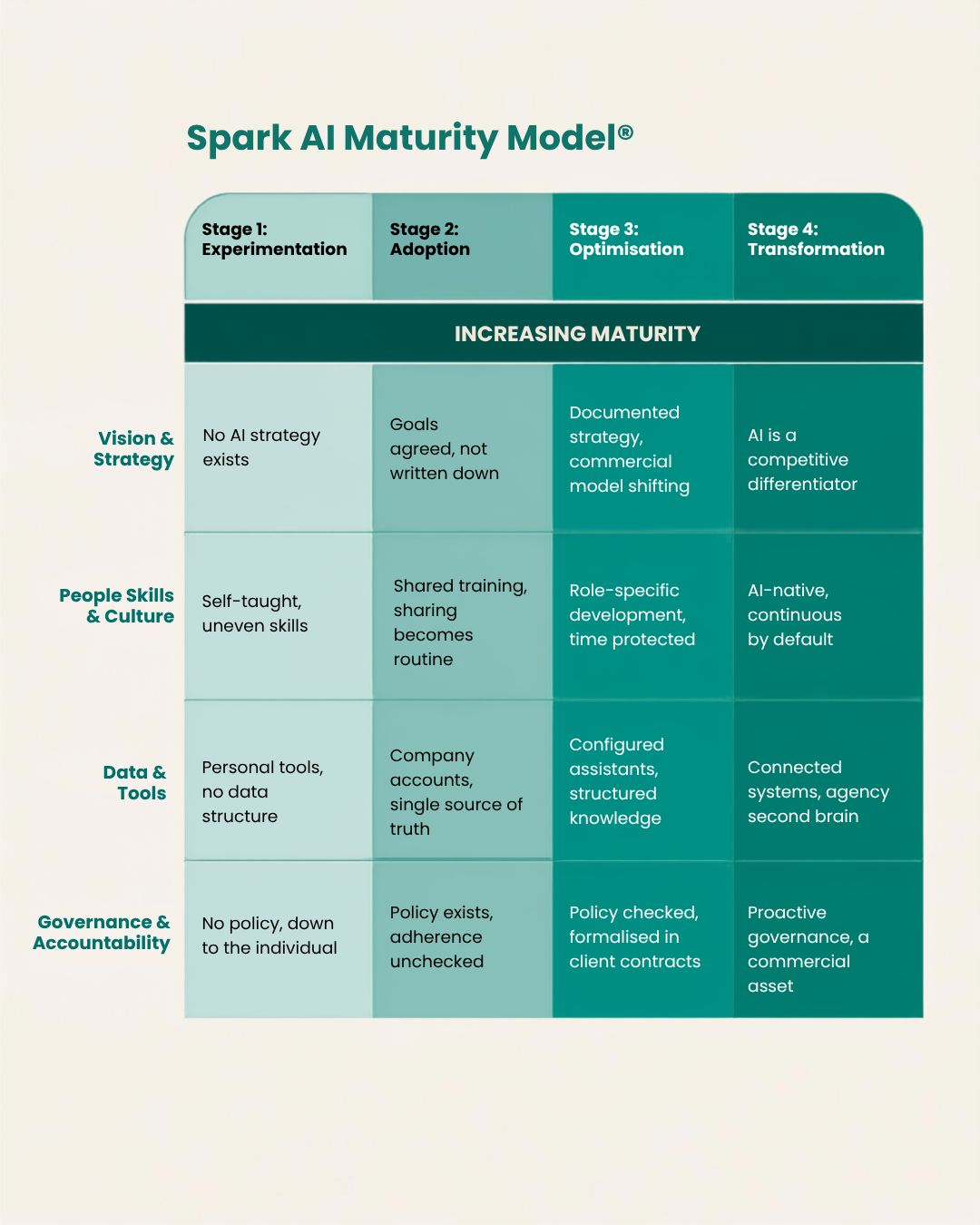
When Spark first began working with agencies in 2024, we expected the creative industry to split into two broad groups: those using AI and those that were not.
The reality was far less simple. We found agencies at very different stages, even when they appeared similar from the outside. Some had strong individual users but no shared standards. Others had built AI into day-to-day workflows but had not yet changed how they charged for their work.
We created the model to describe this variation AI maturity and give agency leaders a shared language for discussing it.
What are the four stages of the Spark AI Maturity Model®?
Experimentation is where AI use is individual and informal. Confidence and quality vary, and there is little shared governance.
Adoption is where the agency begins building common foundations. Teams receive training, policies are introduced and AI starts to appear in selected roles and workflows.
Optimisation is where AI is integrated across teams and operations. Agencies begin redesigning processes and can measure operational or commercial results.
Transformation is where AI influences the agency’s systems, services and business model. It supports new ways of delivering work and creating value.
How do you read the model?
The model assesses an agency across four dimensions:
Vision & Strategy
People skills & Culture
Data & Tools
Governance & Accountability
Each dimension is scored from Stage 1 to Stage 4.
It’s expected that you will score stronger in some dimensions than others. However, your overall maturity is determined by your weakest dimension, because all four need to work together.
For example, an agency cannot move into Stage 3 (where AI becomes a commercial differentiator) if it still lacks formal governance (stage 1).
Progress in one area cannot compensate for a major gap in another.
How do we use the Spark AI Maturity Model®?
As well as creating a shared language, this model has given us consistent way to study longitudinal change across the agency market.
That research is published through the Spark Report, our free bi-annual report on AI maturity across the industry.
The next Spark Report will be our fifth edition and will be published in October 2026.
Which stage are most agencies at?
The Spring 2026 report showed the first signs of maturing into Stage 2, but that progress was uneven. Individuals were beginning to reach Stage 2 in their confidence and use of AI – 83% described themselves as capable users, and 45% were using AI daily. The organisations around them often remained in Stage 1. Only 15% were working at a level that changed how the agency operates, and 52% of AI activity had no formal governance behind it – no shared standards, no approved tools, nothing agreed in client contracts.
Frequently asked questions
When will I be able to find out about the next report?
The report will be launched in October. We will release more details, including early findings, on LinkedIn, through our newsletter, and our podcast.
Why are there four stages when most people are only at stage 1 or 2?
The maturity model is designed to leave room as new practices and business models develop.
How often should an agency reassess its AI maturity?
AI maturity should be measured regularly, not treated as a one-off exercise. Reassessment shows whether earlier gaps have closed, or whether new ones have appeared.
Spark AI – AI training, consultancy and agent building for agencies and brands. Your AI performance partner.