
How did we redesign our Spark Report workflow using AI?
Summary: Every time we produce the Spark Report, we get to see how far AI has come. For our latest edition, we started by looking at what AI could now make possible, then redesigned the workflow around it. Here's how we used Gemini Notebook, vibe coding, skills and agents to change the way we work.
Written Asta Vallis
Date: 22.10.2026
Read length: 5 minutes
Spark AI – AI transformation, training and tools for agencies and brands. Your AI performance partner.
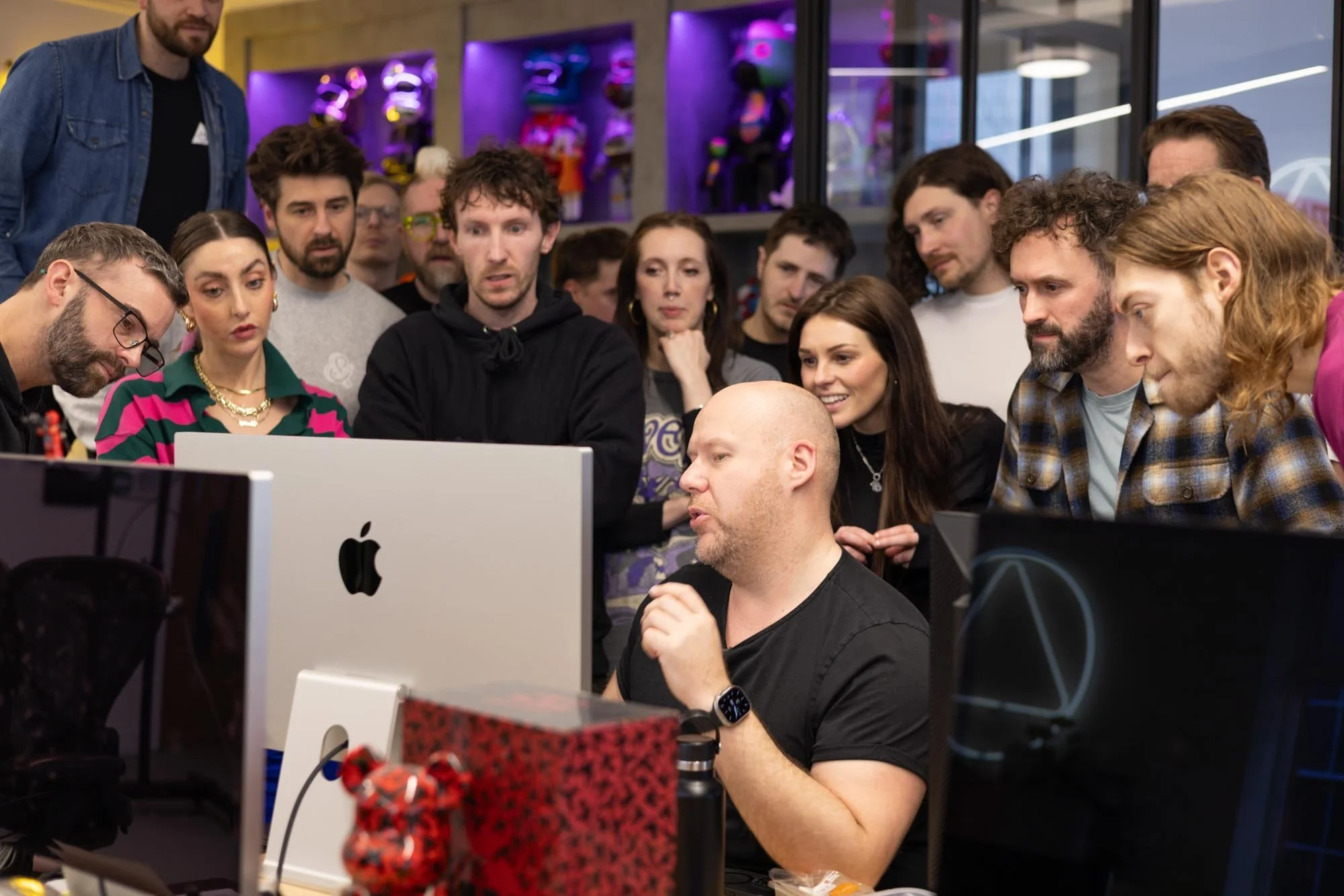
Every six months, we produce the Spark Report, tracking how agencies are adopting AI and what that means for their businesses.
The process gives us two things to think about. First, what has changed in how agencies are using AI? And second, what has changed in the technology itself, and how could we use it to produce the report differently?
Doing the same project twice a year makes it a brilliant barometer of how far AI has come. Every time, it allows us to do things we couldn't before.
Since our Spring report, agentic AI has become much more accessible to use without coding experience. So when we planned this edition, we started with what AI could now do and designed the workflow around it, with our team making the calls throughout.
Here's what that looked like.
How did Gemini Notebook change the way we researched the report?
We brought all the Spark AI Maturity Score™ surveys, secondary research and previous reports into a Gemini Notebook.
This gave us all our sources in one place and helped us investigate patterns, identify trends and run calculations. What's brilliant about Gemini Notebook is that it works from the sources you give it, so you can follow the analysis back to the data it came from and check the findings for yourself.
It also syncs with native Google Docs, Slides and Sheets, so we could update our findings and drafts as we went, and Notebook would have access to the latest material.
We also queried our Spark AI knowledge centre, a separate Notebook holding our content archive, to find relevant examples and exercises.
This changed how we worked with the research. Rather than repeatedly searching through individual documents, we could investigate questions across the full collection, then return to the original evidence to check our interpretations.
How did vibe coding change what we could build?
Back in the Spring, we'd built a simple landing page with a sign-up form for the report as a PDF.
This time, we wanted to go much further. We wanted an animated web version of the report with all its charts and figures, and a better experience for people finding and exploring the research online.
So we used Claude to build it.
Emma, Spark AI's co-founder, is a skilled designer, but not a developer. She knew how she wanted the page to look and behave, but couldn't code it herself.
With Claude, she could describe what she wanted in plain language and see it become a working page. She could use her design experience to build something she couldn't before.
Emma and Asta gave Claude the brand guidelines and previous reports as visual references. It helped them produce the landing page, a PDF mock-up for the graphic designer and the supporting launch assets.
It still needed a lot of direction to get it right.
The web page went through more than 100 iterations. Throughout the process, Emma explained the thinking behind her decisions about headlines, charts and motion, helping Asta understand the design choices and develop her own experience of building with AI.
It was a new way for them to work together, combining Emma's design experience with Asta's involvement in building and refining the report.
AI expanded what the team could produce, but the work still took considerable time and judgement.
How are we using AI skills to keep the team consistent?
Once we'd developed the report and its key messages, we turned them into a shared AI skill for the team.
The skill contains reusable instructions and reference material that anyone working on report content can draw on.
It gives everyone access to the same guidance, helping us keep our messaging consistent across different pieces of content and across the team.
It also knows which findings are embargoed until the report launches, and what we're allowed to say beforehand.
How can agents help after the report launches?
Our workflow doesn't end when the report goes live.
We've also set up an agent that searches for mentions of the report each week and emails Asta links to anything it finds.
This should help us spot coverage we might otherwise miss and see which findings prompt the most discussion.
For Emma, who started her career in media monitoring in the 2000s, it's a particularly interesting change. Back then, the work involved reading articles and manually underlining mentions.
Now, an agent can take care of much of that searching, giving the team more time to look at the coverage and understand how the report is being received.
What did we learn from redesigning the workflow?
One of the biggest lessons was that a redesigned workflow won't necessarily save time, particularly the first time you try it.
In fact, this report probably took longer to produce than previous editions. The website alone went through more than 100 iterations, and every change needed reviewing and checking.
As we worked with Claude, it sometimes lost track of earlier instructions or introduced errors into figures across iterations. This meant we needed rigorous checks throughout the process. We were also working across more versions of the report, making it harder to ensure that every document reflected the latest changes.
Redesigning a workflow also means agreeing on how the team will work together. When part of a process is being built with AI on one person's laptop, how do you share that work, hand it over and make sure someone else can pick up where you left off?
These are the kinds of questions teams need to discuss when they start working differently with AI. We've written more about this in our blog, What does good AI-assisted work look like in your team?.
After completing the report, the team sat down to review the process. What worked well? Where did things become more complicated? And what would we do differently next time?
That conversation is an important part of redesigning a workflow. You're testing a new way of working, and you won't always get everything right on the first attempt.
Throughout the project, we followed our Think – AI – Think approach, starting with our own ideas, using AI to develop and challenge them, and applying our judgement to the results.
The outcome was a report we couldn't previously have produced with the resources available to us.
It took more time, required new ways of collaborating and gave us plenty to improve for the next edition. But it allowed us to create something better.
And when we come to produce the next report, we'll have both a new set of AI capabilities to consider and everything we've learnt from this one.
Frequently asked questions
What does it mean to redesign a workflow around AI?
It means looking at the whole process and reconsidering how the work could be done using the capabilities now available. For the Spark Report, that meant changing how we investigated our research, built the report online, shared guidance across the team and monitored coverage after launch. Read our blog on why agencies should redesign their workflows.
Is AI only an efficiency tool?
No. Our report took longer to produce than previous editions, but AI made it possible to create an experience we wouldn't previously have had the resources to build. Time savings aren't the only measure of what AI makes possible.
How does AI change the way teams work together?
When a team starts building with AI, it also needs to think about how work is shared, reviewed and handed over. New workflows often take several attempts to get right. Reviewing what worked and what didn't helps the team develop a better process for the next project.
Spark AI – AI transformation, training and tools for agencies and brands. Your AI performance partner.