
What are the six components of an AI agent?
Summary: AI agents can sound complicated, but the building blocks are relatively simple. We break down the six components an agent needs.
Author: Asta Vallis
Read length: 4 minutes
Date: 02.09.26
Spark AI is the AI performance partner that builds organisation-wide AI capability for creative agencies and brand teams. We take ambitious teams from fragmented experimentation to AI embedded across their people, processes and systems – so it delivers real commercial impact.
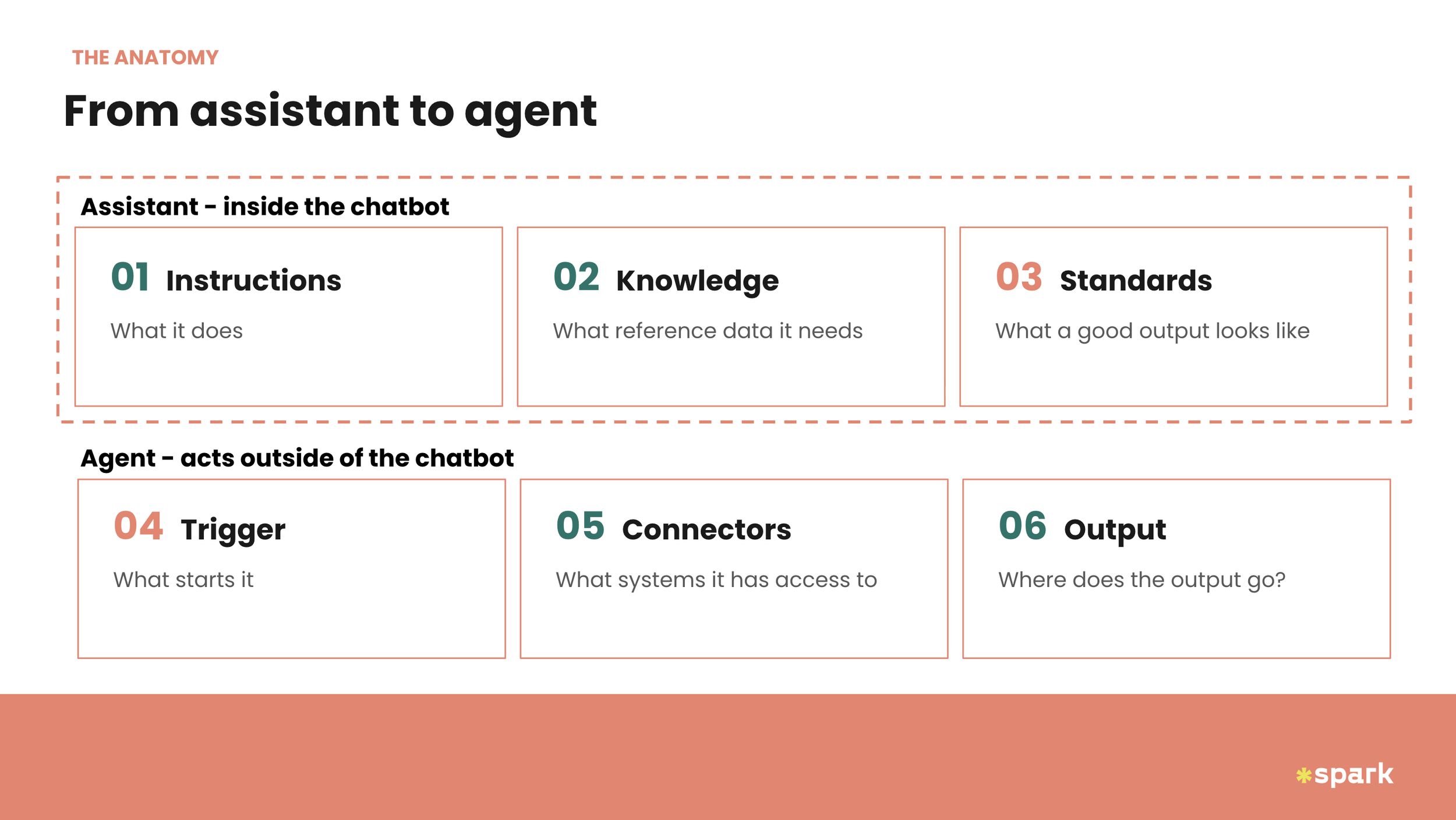
Building AI agents can seem overwhelming. In practice, they are made up of things most teams are already familiar with. During a recent Spark Session, Jules Love, co-founder of Spark AI, broke an agent down into six simple components and showed how you can move from an AI assistant to an AI agent by adding three extra building blocks.
Lets first differentiate between an AI assistant and an AI agent:
An AI assistant typically has instructions, knowledge and standards, but still relies on a person to start the interaction and usually returns its output inside the chat.
An AI agent adds triggers, connectors and external outputs, allowing it to take part in a wider workflow.
1. What instructions does the agent need?
Instructions are the brain of the agent as they define what you actually want it to do.
That could be retrieving information, synthesising research, prioritising tasks, drafting a document, checking something against a standard, updating a system or notifying someone when something happens.
The clearer the instructions, the more useful the agent is likely to be.
2. What knowledge does the agent need?
An AI model may know how to carry out a general task, but it does not automatically know how your agency carries it out.
That is where knowledge comes in.You can give the agent access to templates, SOPs, methodologies, case studies, brand guidelines, briefs or client information.
A useful way to think about this is: if an intern joined your business tomorrow, what would they need to read before they could do this job properly?
3. What does a good output look like?
The third component is standards. An agent needs to know not just what to do, but what “good” looks like.
That might mean defining the sections, structure, tone of voice or audience.
It can also mean giving examples of good and bad outputs and explaining why.
Jules’ advice here is simple: show, don’t just tell.Giving the model examples can often communicate your standard more effectively than trying to describe every rule in words.
At this point, you have the foundations of a strong AI assistant:
Instructions + Knowledge + Standards
So what turns that assistant into an agent?
4. What triggers the agent?
An agent does not always need a person to manually start it.
It can run because something happens.
That trigger might be:
a set time every morning
an email arriving
a status changing in a project-management system
a file being added to a folder
a form being submitted
another agent completing a task
This is one of the important differences between a normal assistant and an agent.
Instead of waiting for someone to open a chat and ask for help, the workflow can start automatically.
5. What systems does the agent need to connect to?
The next component is connectors. Agents become much more useful when they can access the systems where your work already lives.
That could include:
Google Drive or SharePoint
your CRM
project-management software
meeting transcripts
finance systems
email
client data
This allows the agent to work with information about what is actually happening in the business rather than relying only on what is available inside the chat.
But, it is important to consider what permissions should the agent have?
Reading from a system is one thing, but writing into your CRM is another.
The advice from the session was to start conservatively. Give agents the minimum permissions they need, particularly when actions are difficult to reverse.
6. Where does the output go?
Finally, an agent needs somewhere useful to put the result. An assistant might give you an answer in a chat window. An agent can create something outside it.
That might be:
a draft email
a Slack or Google Chat message
a document saved into a folder
a new spreadsheet row
an update in a project-management system
a report delivered to your inbox
This is what turns an AI interaction into a workflow that can really save time.
Frequently asked questions
What is an AI agent?
An AI agent is a narrowly defined AI workflow that can act on a trigger, connect to other systems and produce an output outside the chat.
How can Spark AI help my team build AI Agents?
We have launched Agent Build Sprint. It is a two-day sprint where your team learns to spot the right tasks for an agent, then builds and tests on real work. A week later, we come back to refine what you've built, map what's next, and set you up to share it with the rest of your team.
Do I need specialist software to build an AI agent?
Not necessarily.The Spark Session showed examples across tools agencies may already use, including ChatGPT, Gemini, Claude and Copilot. The exact setup differs by platform, but the six underlying components remain the same.
Spark AI – AI training, consultancy and agent building for agencies and brands. Your AI performance partner.