How do I build a competitor analysis agent?
Summary: Competitor-analysis is an essential part of life for all businesses. However, it is very labour heavy and can be easy for key insights to slip through. A well-briefed agent can monitor the right signals and prepare an evidence-led report, leaving your team with time to interpret what has changed and decide what to do next.
Author: Asta Vallis
Read time: 3 min read
Full date: 10.09.2026
Spark AI is the AI performance partner that builds organisation-wide AI capability for creative agencies and brand teams. We take ambitious teams from fragmented experimentation to AI embedded across your people, processes and systems – so it delivers real commercial impact.

Someone has to revisit the same websites, search announcements, job posts and industry news, and format into a report. It is repetitive work, but skipping it can leave you making decisions with an outdated view of the market.
A competitor analysis agent can take on that repeated monitoring. It can run each week, gather relevant changes and add them to a dated report. Your team then spends its time on the part that needs experience and judgement – deciding which changes matter and what to do about them.
How do I build the agent?
Start with the brief first. Use the checklist below as a guide for what the instructions need to include. Messy notes are fine, as you can feed it to your LLM and ask it to turn them into a structured set of instructions. If you do this, make sure that you always read the instructions back. At Spark, we advocate for Think - AI - Think. Sometimes the LLM can misinterpret what you wanted, creating a poor output.
Once you're happy with it:
On Claude, go to Schedule Tasks.
On Gemini, go to Scheduled actions in settings (Google AI Pro/Ultra or a qualifying Workspace plan).
On ChatGPT, press Agents in the sidebar and select Add.
On Copilot, select Agents in the sidebar and choose New Agent (Microsoft 365 Copilot).
Name it "Competitor Analysis" and paste in your prompt.
What should I include in the instructions?
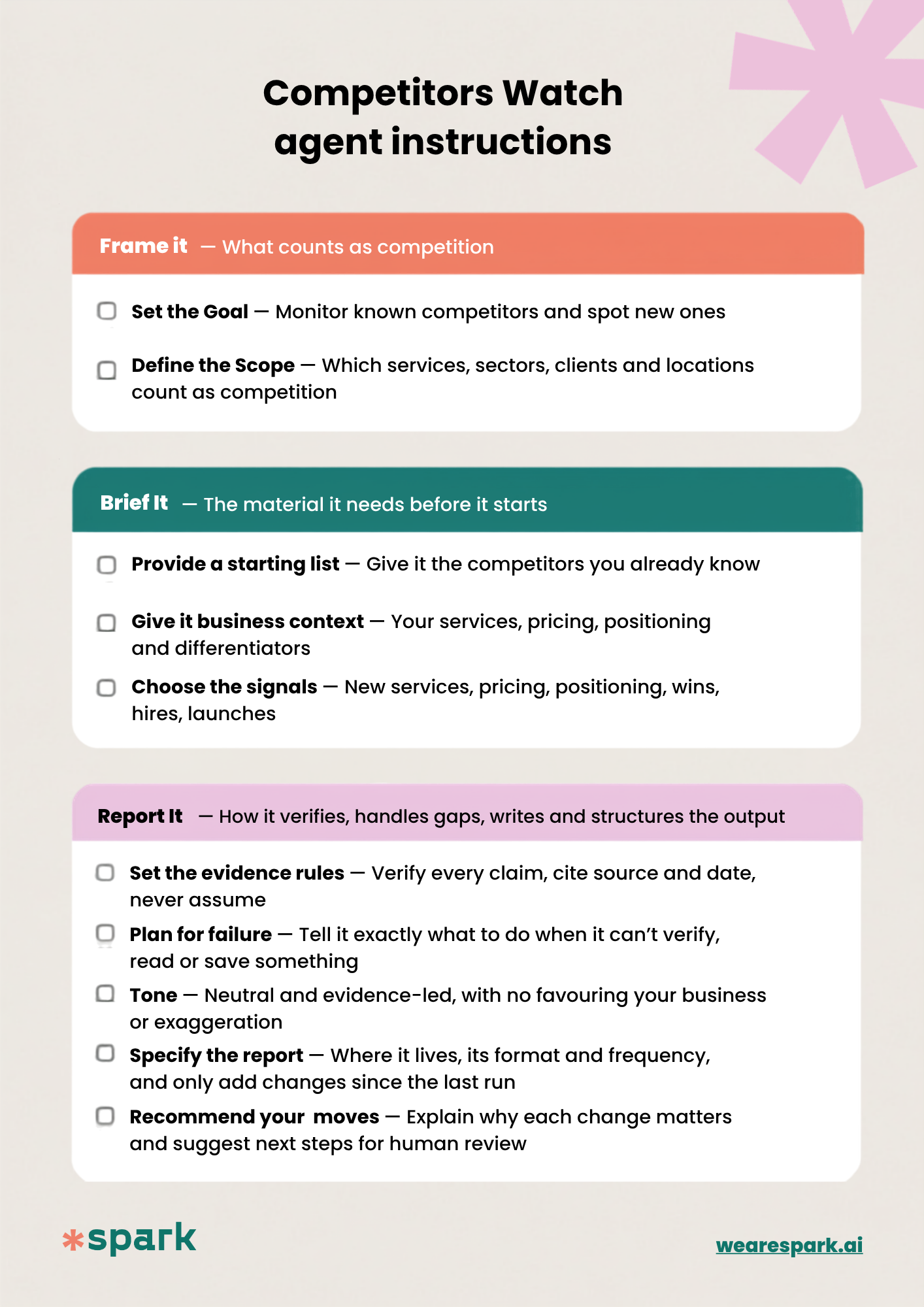
Use this checklist to frame, brief and control the agent before you build it.
1. Frame it
Set the goal – Monitor known competitors and spot new ones.
Define the scope – Be clear about which services, sectors, clients and locations count as competition.
2. Brief it
Provide a starting list – Give it the competitors you already know.
Add your business context – Include your services, pricing, positioning and differentiators.
Choose the signals – Tell it to look for changes such as new services, pricing, positioning, client wins, hires and launches.
3. Define the report
Set the evidence rules – Require it to verify every claim, cite the source and date, and never fill gaps with assumptions.
Plan for failure – Explain what it should do when it cannot verify, read or save something.
Set the tone – Ask for neutral, evidence-led reporting without favouring your business or exaggerating a competitor’s activity.
Specify the output – Decide where the report will live, how it will be structured, how often it will run and that it should add only new changes.
Ask for suggested moves – Have it explain why each change may matter and suggest next steps for human review.
Share this checklist with your team:
Where should the human stay involved?
Have a named owner for the task. Make sure you have approvals on, save reports as drafts and review the evidence before acting on any recommendation.
It might take a few iterations to get the output right. It's worth making those corrections to the instructions as you go. You can always paste the current instructions into an LLM and ask it to improve it based on your feedback.
Want to build useful agents with your team?
We’ve launched the Agent Build Sprint, a two-day programme that gives your team the skills to build and use agents inside your business.
On day one, we help you choose the right internal tasks, map how they should work and build the first versions around your own systems and standards. Your team then tests them on live work for a week.
When we return, we fix any weak spots, put the right controls in place and document how everything works.You leave with two or three useful agents, plus the skills to build and improve more yourselves.
Want help choosing and building useful agents for your business? Let's talk
Frequently Asked Questions
What actually is an agent?
In practical terms, an agent is a narrowly defined AI workflow that can act on a trigger, connect to other systems, and produce or update something outside the chat. It might monitor a CRM or compile a report. If you want to know about the 6 steps that make up an agent, read this blog.
Do I need to be technical to build an agent?
No. If you can write a clear brief, you can write agent instructions – the checklist in this piece covers what to include, and the LLM does the tidying up. Where it gets harder is judgement: knowing what good output looks like and catching when the agent's drifted.
Can I learn more about building agents like this one?
View our Spark Session with Jules Love, where he discusses what Agents mean for Agencies. He sets out the six components that forms an agent, demos agents running live in Claude, ChatGPT and Gemini, and works through the parts of agency work that should stay with people. Watch here.
Spark AI – AI training, consultancy and agent building for agencies and brands. Your AI performance partner.