Should agencies start with AI strategy or AI skills?
AI strategy for agencies / AI process redesign
Summary: It's the question leadership teams disagree about in front of us most often. The sequence matters far less than whether you redesign the process – one agency leader at Cannes put the difference at 1.2x against 6x.
Date: 07.08.2026
Author: Emma Wharton Love
Read length: 4 minutes
Spark AI is the AI performance partner that builds organisation-wide AI capability for creative agencies and brand teams. We take ambitious teams from fragmented experimentation to AI embedded across your people, processes and systems – so it delivers real commercial impact.
We've watched leadership teams debate this up close. One side wants an AI strategy before anyone touches a tool. The other wants people skilled up first, on the grounds that you can't write a strategy about something nobody has used.
Both positions are defensible, and the argument is mostly a distraction, for real change and real ROI you need both.
Why does AI process redesign beat bolting AI onto existing workflows?
Because redesign changes what the process is, while bolting AI on only speeds up a step. One agency leader at Cannes this summer put numbers on it inside their business: adding AI to an existing process gets you roughly 1.2x productivity, but redesigning the process with AI in mind can get you 6x. It's an anecdote rather than a study, but it matches what we see in client work.
There are two reasons the difference is that large. The first is collapsing steps. Humans tend to work through a process one stage at a time: brief, write, check, build. AI can run several of those stages at once, so the process doesn't need to be broken into that sequence to begin with. The second is capability that didn't exist before. Not new in the sense of magic – more that something which would have taken so long by hand that nobody realistically attempted it becomes possible inside a normal working day. Both compound as the models improve. Having the redesigned process in place is what lets you take advantage of the next model release rather than starting the conversation again.
What does an agency rebuilt around AI look like?
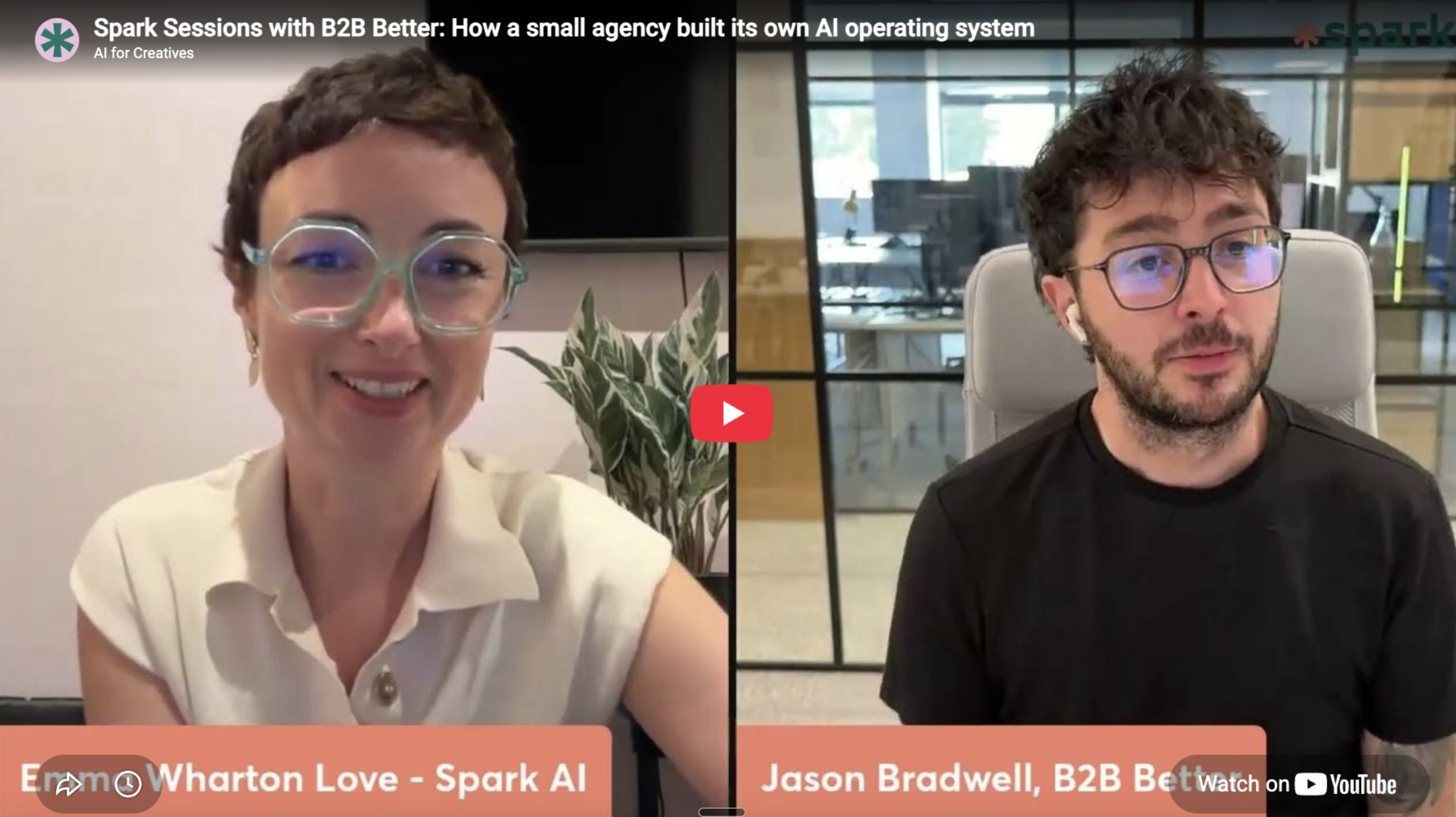
My webinar with Jason from B2B better
It looks like an internal operating system where the workflows live, rather than a set of AI tools bolted to the old process. Some of the most interesting AI work right now is coming out of the smallest agencies. Jason Bradwell founded B2B Better, an agency in Bournemouth that helps leaders turn their point of view into business advantage, through podcasts. Seven months ago he saw the opportunity AI represented for his business.
Rather than applying AI to his existing workflows, he built B2B Hub: an internal operating system where the agency's workflows now live, redesigned around what AI can do. Two examples from his build show both mechanisms at work. His near-instant landing pages are the collapsed-steps case. One prompt covers copy, imagery and build, referencing his brand guidelines and tone of voice. A page that would normally move through four separate stages comes back as a working first draft. His "Counsel" is the new-capability case. His team can put a real decision to eight different perspectives – a risk analyst, a customer advocate and a sceptic playing devil's advocate among them – and get a considered recommendation back in under five minutes. Nobody was commissioning that kind of review before, because nobody had the days it would have taken. He's also built his own software tools, replacing subscriptions with versions shaped around how B2B Better works. That cuts considerable cost, and it means the features match what the agency wants rather than what a vendor's roadmap allows. Being small works in his favour. Decisions move fast without layers of approval. It also changes the risk of trying something new: at that size client relationships tend to be closer, so an experiment that doesn't land is a conversation rather than a crisis.
Are AI skills specialist?
No. The core skills for working with AI need no technical background, which is why the historic advantage of large networks has narrowed. Historically the large agencies and networks adopted new technology first. Specialist skills and capital were the price of entry, and that made it hard for smaller agencies to compete. AI has changed the terms. Subscription costs sit comfortably within reach of a small team, and the core skills aren't specialist. Spark AI groups them as four abilities:
Description – briefing AI properly, giving it the full context
Discernment – knowing what good and bad output looks like
Delegation – judging what to use AI for and what to keep human
Dialogue – having the right conversation with AI to direct it Which brings the strategy-or-skills argument to its actual answer.
When everyone has roughly equal access to the technology and the skills aren't specialist, the binding constraint is leadership direction: someone deciding which processes get rebuilt, and giving people room to rebuild them.
What does this mean for larger agencies?
Larger agencies have the resources but not the turning circle, so the first move is making AI leadership clear and visible. PwC's 2026 Digital Trends in Operations survey found that 93% of the 767 operations leaders polled agree that affordable cloud and AI tools help smaller firms reach parity with digital leaders. Recognising it and acting on it are different things. Larger businesses have the resources to stand up innovation teams, a real advantage, but are bound by layers of approval they find it much harder to turn the ship. A team that wants to rebuild a process needs to focus as much on the decision making and stakeholder management as much as the process redesign and technology side.
How do you run an AI process redesign?
Work through five steps with your team on a single process. The exercise comes from Spark AI co-founder Jules Love's book, Shift – AI for Agencies.
Jules argues that most agencies treat AI like a Swiss Army knife: a handy tool people reach for when they need a quick fix.
Document what should happen. Don't map how things are done today, workarounds and habits included. Design the ideal version of the process – client onboarding, creative ideation, whatever you've chosen – from a blank slate.
Break each activity into key tasks. Take that ideal process and pull out what's needed to make it excellent. Don't worry about efficiency yet.
Identify the data needed. For each task, work out what AI would need in order to be briefed properly: institutional memory, briefs, guidelines, whatever applies.
Run the human-or-AI-lead test. For every task, decide who's in charge. AI should lead the graft – data synthesis, competitor research – with a human keeping oversight. Humans should lead wherever relationship building or creative judgement is doing the real work, with AI supporting.
Build the agent. Only once the process is fully re-mapped should you choose which tools you need – Gemini Gems, Copilot agents, and so on – and keep that list as short as you can. The order matters. Step 5 is where most agencies start, which is why so many end up with a folder of assistants nobody opens.
Frequently asked questions
So is the answer AI strategy first?
The answer is redesign first, with enough skill in the room to know what's possible. A strategy written by people who've never built anything with AI tends to describe the current process with AI bolted to it, which is the 1.2x outcome. Get a small group fluent, pick one process, rebuild it properly, then write the strategy from what you learned. We accelerate you through this process in the Spark AI Accelerator.
Does AI process redesign only work for small agencies?
Small teams have an agility advantage, not a capability advantage. The mechanism – collapse steps, then look for work that was previously impractical – applies at any size. What changes at scale is that someone senior has to make the authority to redesign explicit, or approval layers will return the process to its old shape.
How long does an AI process redesign take?
B2B Better's operating system came together over seven months, and that was a founder rebuilding his own agency. For one process inside a larger business, a few weeks of deliberate work is more typical. Start with a process you own outright rather than one crossing three departments.
What are the four core AI skills?
Spark AI's 4Ds framework: Description (briefing AI with full context), Discernment (judging output quality), Delegation (deciding what to give AI and what to keep human) and Dialogue (directing AI through conversation). None requires a technical background.
Want to work through this with your team? Shift – AI for Agencies has more case studies and exercises, and you can watch the full Spark Session with Jason Bradwell, including a live demo of B2B Hub, here.
Where can I find more AI insights like this?
Spark Intelligence, Spark AI's fortnightly newsletter for creative leaders, carries a practical exercise in every issue.
Spark AI – AI training, consultancy and agent building for agencies and brands. Your AI performance partner. https://www.wearespark.ai/